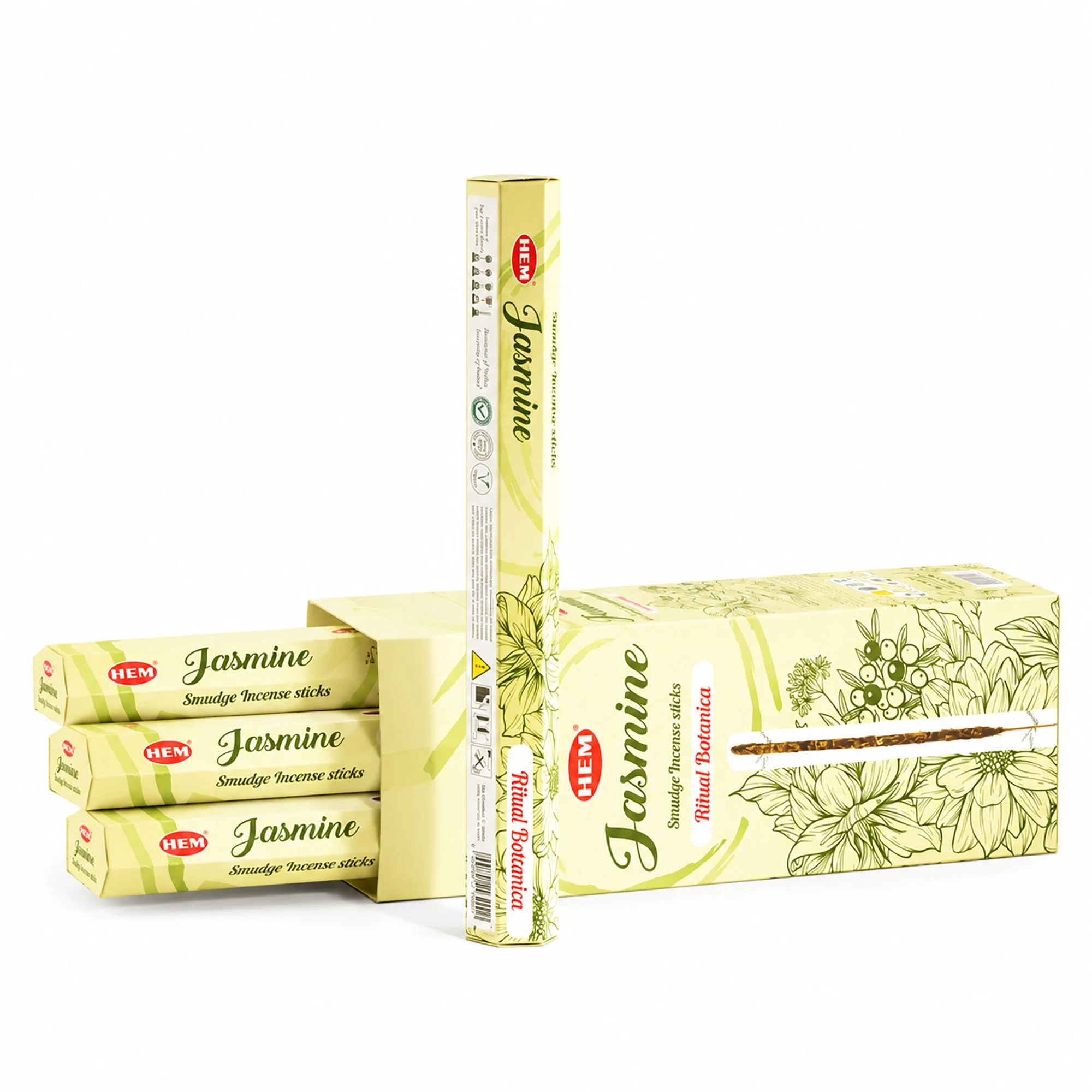
HEM makes an unusually broad range of incense, which is useful once you know what you like but can make a first purchase feel harder than it needs to be. This guide breaks the range into simple fragrance families and formats so you can choose by scent rather than by a promise on the packet.
If you already know what you want, browse the full HEM Incense collection. If not, start here.
What is HEM incense?
Within the Ember & Thorne range, HEM covers classic hexagonal incense sticks, the Precious line, Palo Santo Masala blends, Smudge fragrances and boxed multi-fragrance collections. The common thread is choice: there are familiar floral, woody, resinous, sweet and aromatic scents rather than one single “HEM smell”.
That means the most useful way to shop HEM is by fragrance direction and format. A name such as sandalwood, lavender or frankincense tells you more about whether you are likely to enjoy the product than any symbolic association attached to it.
How the HEM ranges differ
Choose HEM incense by fragrance family
You do not need to know incense terminology. Think about the kinds of scents you already enjoy elsewhere in the home.
Fresh, herbal and cleansing-style fragrances
HEM Precious White Sage is the obvious place to begin if you like dry, herbal and aromatic scents. HEM Palo Santo sits in a woodier direction, while the Smudge range gives you alternative interpretations of those familiar fragrance names.
Woody and earthy fragrances
HEM Sandalwood is a useful starting point if you prefer warm, woody fragrance. Chandan is also associated with a sandalwood-style profile, while patchouli moves further towards earthy and distinctive. These are sensible choices for people who find sweet floral incense too perfumed.
Resinous and deeper fragrances
HEM Frankincense and HEM Dragon’s Blood sit at the richer end of the range. The Palo Santo Masala Myrrh and Smudge Frankincense & Myrrh lines add another option if you prefer darker, resin-led fragrance profiles.
Floral fragrances
HEM Precious Lavender is a straightforward first floral choice. Jasmine, rose and ylang ylang give you different directions within the same broad family: jasmine tends to read as richer and sweeter, rose as recognisably floral, and ylang ylang as more exotic and perfumed.
Sweet and spiced fragrances
Vanilla and coconut are the softer, sweeter options in the range. Cinnamon is warmer and spicier. These can work well if you prefer home-fragrance scents that feel closer to candles and room fragrance than traditional resinous incense.
Five HEM fragrances that make sense for a first order
If you are choosing without having smelled HEM before, these give you five noticeably different directions:
- Precious White Sage — aromatic and herbal.
- Sandalwood — warm and woody.
- Precious Lavender — floral and familiar.
- Frankincense — deeper and resinous.
- Dragon’s Blood — darker and more distinctive.
There is no objective “best” HEM fragrance. A sensible first basket is a small spread across fragrance families; after that, buying becomes much easier because you know whether your preference runs floral, woody, sweet, herbal or resinous.
When the Palo Santo Masala range makes sense
The Palo Santo Masala products are useful when you want something more layered than a single named fragrance. Ember & Thorne currently carries combinations with lavender, cinnamon, sandal, myrrh, arruda and rose. Rather than buying them because of a claimed effect, choose the pairing that sounds closest to the fragrance balance you normally enjoy.
For example, Palo Santo Masala Sandal stays in a woody direction, while Palo Santo Masala Rose moves towards floral. The lavender version sits between aromatic and floral.
HEM Smudge incense: what the name means here
The HEM Smudge products in this collection are incense products; they are not loose bundles of dried herbs. Names such as White Sage, Palo Santo and Frankincense & Myrrh describe the fragrance direction of the product. That distinction matters if you are comparing them with traditional botanical smudge bundles.
The collection sets are the easiest way to explore several scents
If you would rather try a group of fragrances than choose one pack at a time, the HEM six-fragrance collections are the most convenient option. Each also includes an ashcatcher, so they work particularly well as a first incense purchase or a small gift.
- HEM Resin Incense Collection — for deeper, resin-style fragrances.
- HEM Woody Incense Collection — for warmer wood-led scents.
- HEM White Sage Incense Collection — a White Sage-led assortment.
How to burn HEM incense safely
Use a stable incense holder that catches the ash and place it on a heat-resistant surface. Light the tip of the stick, allow it to catch, then blow the flame out so the tip smoulders. Keep burning incense away from curtains, paper and other combustible materials.
Ventilate the room, especially in smaller spaces, and never leave incense burning unattended. Keep it out of reach of children and pets. If smoke or fragrance causes discomfort, extinguish it and air the room rather than trying to “get used to” the scent.
Does HEM incense smell the same before and after lighting?
Not necessarily. Incense can smell sweeter, smokier or more resinous once it is burning than it does in the packet. Fragrance descriptions are therefore a useful direction rather than an exact prediction. Room size, ventilation and your own sensitivity to fragrance all affect how strong it feels.
How long does a HEM incense stick burn?
Burn time varies with the product, airflow and how the stick is made, so we would rather not give one universal minute figure for the whole HEM range. Product packaging should be treated as the best source when a specific burn time is stated.
Which HEM incense should you choose?
If you want the shortest answer: start with the fragrance family you already like. Choose White Sage or Palo Santo for aromatic profiles, Sandalwood for warm wood, Lavender or Jasmine for floral fragrance, Frankincense or Dragon’s Blood for something deeper, and Vanilla or Coconut if you prefer sweeter home fragrance.
Or skip the decision completely and start with one of the HEM collection sets and incense packs. For a ready-made introduction, compare the HEM Resin Collection, HEM Woody Collection and HEM Smudge Jasmine. Once you have found one or two scents you genuinely enjoy, the rest of the range becomes much easier to navigate.